
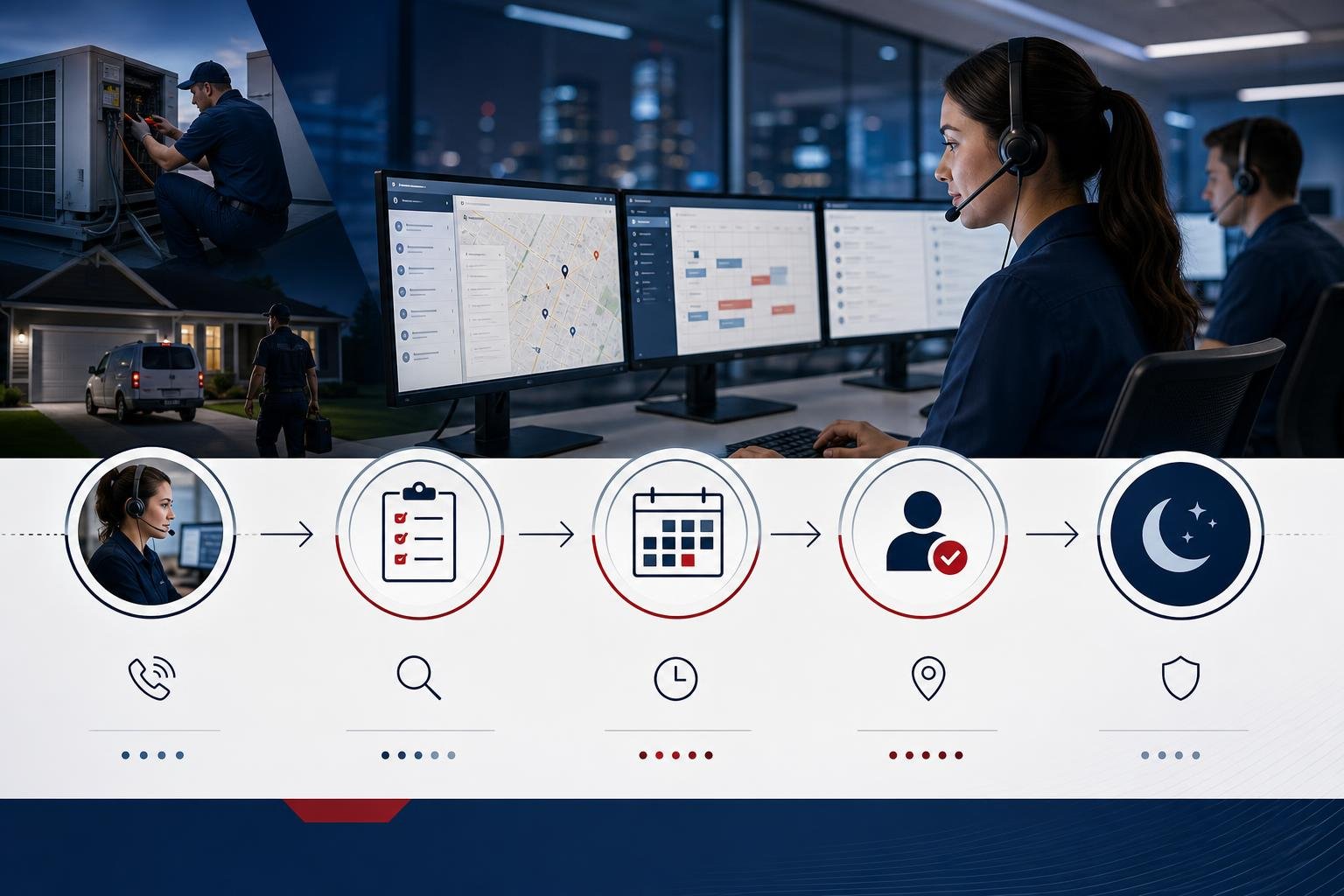
When call volume spikes, techs run behind, and the board changes all day, dispatch becomes the bottleneck that quietly drains revenue—missed calls, bad bookings, no-shows, and overtime that didn’t need to happen. Outsourcing HVAC dispatch is often less about “saving money” and more about building reliable coverage and a repeatable process that protects booked work.
This guide breaks down what an outsourced HVAC dispatcher can realistically take off your plate, how to choose a coverage model (including after-hours/weekends), what drives costs, and the SOPs/KPIs that prevent the most common handoff failures.
Executive Summary
- Define dispatch scope: call intake, scheduling/rescheduling, confirmations, and basic triage—while keeping pricing approvals and escalations with in-house leadership.
- Pick a coverage model (business hours, extended hours, after-hours/weekends) and set SLAs like speed-to-answer and booking accuracy.
- Document a simple dispatch SOP: scripts, triage/eligibility rules, scheduling rules, escalation paths, and required notes in your CRM/field-service system.
- Onboard for reliability: call routing, systems access, shadowing, a QA review cadence, and reporting the client controls.
- Track KPIs that prove ROI: booked jobs per lead, answer rate, abandoned calls, schedule utilization, and revenue protected from missed calls.
What “outsourcing dispatcher HVAC” typically means
In most HVAC companies, “dispatch” actually blends four functions: inbound call handling, appointment setting, schedule/route coordination, and customer updates. When you outsource dispatch, you’re typically delegating repeatable, high-volume coordination work so your in-house leaders can focus on pricing, exceptions, and technician management.
If you’re evaluating an outsourced HVAC dispatcher, the operational success comes down to two things: (1) clear scope and rules, and (2) a daily communication rhythm your team controls.
Core responsibilities an outsourced dispatcher can handle
- Inbound call intake during defined coverage windows (business hours, overflow, after-hours).
- Scheduling and rescheduling using your rules (service area, job types, time windows, technician capabilities).
- Confirmations (same-day, next-day, “tech en route” calls/texts if your system supports it).
- Basic triage (no-cool/no-heat urgency, safety prompts, membership status, warranty checks—based on your policy).
- Board hygiene: accurate notes, tags, job types, and required fields so techs aren’t walking into surprises.
- Customer ETA updates and coordination when the schedule shifts.
Tasks that should remain with your in-house leadership
Keep decisions that require authority, risk judgment, or deep context with your in-house owner/ops lead/service manager. Common “stay in-house” areas include:
- Pricing approvals, discounts, and exception handling (especially for high-ticket or complex work).
- Complex diagnostics beyond your triage script (e.g., ambiguous symptoms, repeated failures, equipment history issues).
- Customer escalations (refund demands, severe complaints, threats of chargebacks/reviews).
- Capacity decisions like adding overtime, rerouting to hit SLAs, or pulling techs off jobs.
- Policy setting: service area boundaries, emergency definitions, after-hours rules, and membership priority.
Independent contractor model and client day-to-day control (important for compliance)
With Global Staff Services, dispatchers are independent contractors. The client maintains day-to-day control over the work: you interview and select the contractor, set priorities, provide scripts/SOPs, define working hours/coverage, evaluate performance, and approve hours. GSS supports sourcing and vetting, administrative infrastructure, contractor-payment facilitation, and optional client-controlled transparency tools.
Coverage models: business hours vs after-hours vs weekend dispatch
The right coverage model depends on your lead sources, emergency call mix, and how much revenue you lose to missed calls. “More hours” only helps if you have a clear booking policy and a clean handoff between shifts.
When 24/7 coverage is worth it (and when it isn’t)
24/7 (or true after-hours) dispatch can be worth it when:
- You run emergency service and can credibly respond (on-call techs, clear emergency criteria, fees/policies set).
- You have meaningful after-hours lead flow (PPC/LSA, answering service overflow, repeat customers calling evenings/weekends).
- Missed calls become missed jobs (competitors answer and book while you call back the next day).
It may not be worth it when:
- Your team can’t fulfill after-hours work reliably (no on-call rotation or unclear service boundaries).
- After-hours calls are mostly price shoppers or non-urgent inquiries you can capture via voicemail/text-back.
- You don’t have an escalation path for true emergencies.
Handoff workflows between shifts and on-call techs
After-hours dispatch fails most often during handoffs. Build a simple, consistent workflow:
- Shift-end recap: open tickets, pending confirmations, callbacks owed, parts holds, and any customer sensitivity notes.
- On-call tech contact rules: when dispatch can call/text the tech, what info must be provided, and how to document the result.
- Morning transition: a “first hour” checklist for the daytime team to validate overnight bookings, confirm addresses, and re-check availability.
How to prevent double-booking and missed confirmations
Double-booking typically comes from unclear ownership and inconsistent status updates. Prevention is mostly process:
- Single source of truth: one scheduling board/system (not a separate spreadsheet).
- Status discipline: standardized statuses like “Booked,” “Confirmed,” “En Route,” “Reschedule Requested,” “Needs Approval.”
- Lock rules: define who can move same-day jobs, when a job can be reassigned, and which fields are mandatory before booking.
- Confirmation cadence: same-day confirmations for afternoon windows; next-day confirmations for morning windows; document contact attempts.
Costs and ROI levers for outsourced HVAC dispatch
Cost is driven less by “dispatcher” as a title and more by coverage, workload, and complexity. Before you compare options, define the scope and service level you expect, then estimate what outcomes matter (missed-call recovery, better booking accuracy, fewer schedule gaps).
What drives cost: coverage window, call volume, complexity, systems
- Coverage window: business-hours only vs extended hours vs after-hours/weekends.
- Call volume: average calls per day, seasonal spikes, and peak-hour clustering.
- Complexity: multiple job types, multiple service areas, membership tiers, warranty policies, or multi-crew constraints.
- Systems: field service/CRM setup, phone routing, templates, and how “clean” your existing data is.
- Dedicated vs shared: a dedicated contractor can build deeper context and consistency, which often improves accuracy as volume grows.
ROI math: missed-call recovery, higher booking rate, better tech utilization
Most HVAC owners see ROI from three levers:
- Missed-call protection: more answered calls and faster response to voicemails/forms.
- Higher booking accuracy: fewer wrong job types, fewer “can’t access” issues, fewer address/eligibility mistakes.
- Better schedule utilization: fewer dead gaps, fewer last-minute cancellations without backfill, tighter routes when your rules support it.
To quantify it, track a baseline for 2–4 weeks (answer rate, abandoned calls, booked jobs per lead, reschedule recovery). After outsourcing, compare trend lines—not single-day performance.
Hidden costs to plan for: onboarding time, SOP creation, QA
Even when outsourced dispatch is a strong fit, plan for “setup cost” in time and attention:
- SOP creation: scripts, triage rules, scheduling rules, and escalation definitions.
- Systems hygiene: templates, required fields, tags, job types, and service area mapping.
- QA time: call reviews, ticket audits, and coaching feedback—especially in the first 30–60 days.
SOPs and scripts that make outsourced dispatch successful
A dispatcher can only be as consistent as the rules you give them. The goal isn’t a 40-page manual—it’s a simple SOP that removes guesswork and creates predictable outcomes.
Call scripts: new service, no-heat/no-cool, maintenance, reschedule
At minimum, create four scripts with required questions and mandatory documentation:
- New service call: problem description, system type/age (if known), service address, gate/parking notes, preferred windows, membership/warranty prompts.
- No-heat/no-cool: safety prompt (e.g., gas smell guidance per your policy), age/maintenance history questions, urgency criteria, and escalation triggers.
- Maintenance/tune-up: plan eligibility, seasonal demand messaging, and upsell boundaries (what dispatch can/can’t promise).
- Reschedule/cancel: reason codes, rebooking rules, and when to offer a waitlist or same-day fill slot.
Triage rules: emergencies, warranty, service area, membership priority
Write triage rules as “if/then” decisions. Examples you can adapt:
- Emergency definition: what qualifies for after-hours booking and what becomes next-business-day.
- Service area: zip codes/regions you serve, plus clear rules for “borderline” addresses.
- Warranty/vendor: what info is required to book (model/serial, install date, paperwork) and when to escalate.
- Membership priority: how to prioritize and what benefits dispatch can offer (earlier windows, reduced fees—only if approved by your policy).
Escalation matrix and approvals (pricing, exceptions, unhappy customers)
Create an escalation matrix that answers two questions: who decides and how fast. A simple matrix includes:
- Pricing approvals: who can approve after-hours fees, diagnostic rates, or discounts.
- Exceptions: out-of-area requests, last-minute special time windows, “call the tech directly” demands.
- Customer dissatisfaction: when to escalate immediately vs schedule a manager callback.
- Operational blockers: parts holds, repeat trips, warranty conflicts, or repeated no-shows.
Systems checklist: field service, CRM, phones, and documentation
Good dispatch requires fast access to the right information and consistent documentation. Your tools matter, but your process matters more. Keep it process-agnostic so it works whether you’re on ServiceTitan, Housecall Pro, Jobber, or another platform.
Common stacks: ServiceTitan/Housecall Pro/Jobber (process-agnostic guidance)
Regardless of platform, ensure the dispatcher can:
- View availability and job windows accurately
- Create/edit customer records and jobs with required fields
- Tag job types and priority correctly
- Document call notes in a consistent format
- Trigger confirmations/follow-ups (if your system supports it) or document manual attempts
Required data capture in every ticket
Define a “minimum viable ticket” so techs stop calling the office for basics:
- Full service address + access notes (gate code, pets, parking)
- Contact name/number + preferred communication method
- Problem description in customer words + any required triage answers
- System type (and age/model/serial if your workflow needs it)
- Membership/warranty status (or “unknown” with next-step instruction)
- Scheduling window + booking rationale if it’s an exception
Security basics: least-privilege access and auditability
Set the dispatcher up with the access they need—and nothing more:
- Least-privilege permissions in your FSM/CRM (limit exports, financials, and admin settings unless required).
- Named user logins (avoid shared credentials) so changes are attributable.
- Document standards so you can audit bookings and call outcomes.
- Clear offboarding steps if coverage changes (access removal checklist).
KPIs and QA: how to manage quality without micromanaging
Managing outsourced dispatch isn’t about hovering—it’s about setting measurable standards, reviewing a small sample consistently, and tightening the SOP when patterns appear. The client controls the KPIs, the review cadence, and the coaching priorities.
Operational KPIs: speed-to-answer, abandon rate, booking accuracy
- Speed-to-answer: average and during peak hours; set an SLA that matches your marketing spend.
- Abandoned call rate: track by time of day to detect coverage gaps.
- Booking accuracy: wrong job type, wrong address, missing required fields, booked outside service area, or missed eligibility checks.
- Confirmation completion: % of appointments confirmed per your cadence.
Revenue KPIs: booked jobs per lead, reschedule recovery
- Booked jobs per lead: measure by source if possible (PPC vs organic vs existing customers).
- Reschedule recovery rate: how many cancel/reschedule calls end in a rebooked appointment.
- Schedule utilization: fewer dead gaps, fewer last-minute empty windows, reduced idle time.
QA cadence: call reviews, error categories, coaching loop controlled by the client
A simple QA system that works:
- Weekly sampling: review a small set of calls/tickets (e.g., 5–15) across job types.
- Error categories: documentation error, eligibility error, scheduling error, customer experience error.
- One improvement per week: update the SOP/script, then watch the metric for change.
- Feedback loop: the client provides coaching notes and clarifies rules; the dispatcher applies them on future calls.
How to choose an outsourced HVAC dispatch partner
The provider matters, but the fit is mostly about continuity, ramp time, and whether the partner can reliably source dispatch talent that follows your process.
Questions to ask about staffing continuity, backups, and ramp time
- How do you handle coverage if the dispatcher is unavailable?
- What does ramp time look like for my schedule and call volume?
- Can I scale coverage seasonally (more hours in peak months)?
- How are candidates screened for HVAC/home-services dispatch experience and communication quality?
- What’s the process if we need a replacement contractor?
Proof points: documented SOPs, reporting samples, references
Ask for examples of:
- Onboarding checklists (systems access, scripts, routing setup)
- Reporting samples (daily/weekly summaries you can tailor)
- SOP templates you can adapt to your policies
- References from similar service businesses (when available)
When a dedicated dispatcher is the right next step
A dedicated dispatcher becomes more compelling when you have:
- Consistent daily volume that justifies full-time or near-full-time coverage
- Multiple crews or multiple job types that require more context
- Frequent schedule changes where speed and accuracy impact customer satisfaction
- A mature SOP and KPI rhythm you want someone to execute consistently
FAQ
What tasks can an outsourced HVAC dispatcher handle vs what should stay in-house?
Outsourced dispatch typically handles inbound call intake, scheduling/rescheduling, confirmations, ETA updates, and basic triage based on your rules. Keep pricing approvals, complex diagnostics, customer escalations, and major capacity decisions with your in-house leadership so authority and accountability stay clear.
How do you handle after-hours and weekend HVAC dispatch without losing context?
Use a defined coverage policy (what qualifies as emergency, who is on-call, and what can be booked), a shift-end recap of open items, and consistent ticket notes in one system of record. The morning team should run a short validation checklist on overnight bookings and confirmations.
What KPIs should I track to know outsourced dispatch is working?
Track operational KPIs (speed-to-answer, abandoned calls, booking accuracy, confirmation completion) and revenue KPIs (booked jobs per lead, reschedule recovery, schedule utilization). Compare against a baseline from the weeks before outsourcing and review trends weekly.
How long does it take to onboard an outsourced dispatcher for ServiceTitan or similar systems?
Onboarding time depends on how clear your SOP is, how clean your job types/required fields are, and how your phone routing is set up. A practical approach is a staged ramp: systems access + scripts first, then shadowing, then a controlled go-live with weekly QA and SOP updates during the first 30–60 days.
How do I keep quality high (and prevent bad bookings) with an outsourced dispatcher?
Set non-negotiables (required fields, eligibility rules, escalation triggers), then run a light but consistent QA cadence: weekly call/ticket sampling, error categorization, and one SOP improvement per week. This manages quality through clear standards and feedback—not micromanagement.
Next step: scope your dispatch role before you outsource
If you want outsourced dispatch to work smoothly, start by writing a one-page scope: coverage hours, SLAs, booking rules, escalation paths, and the required notes for every ticket. Once that’s clear, you can confidently interview and select a dispatcher who will follow your process and help protect revenue from missed calls.